|
Pokhara
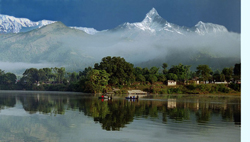
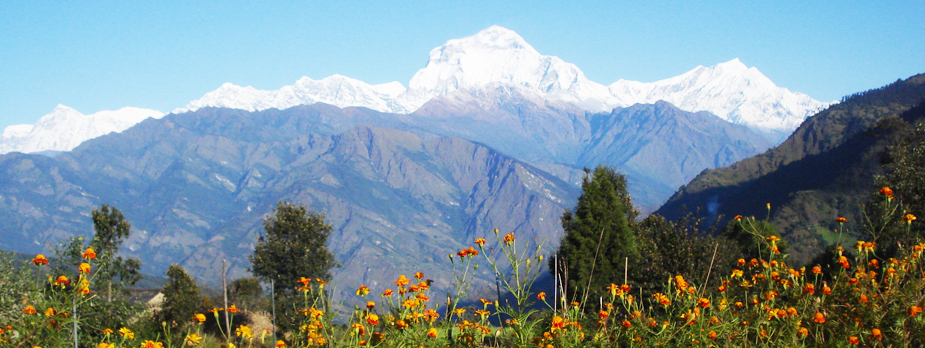
Visitors to Pokhara are always amazed at the diversity of this lake city, built on a level of a mere 931 meters while just 50 kilometers away looms one of the world’s highest peaks, Annapurna, 8,091 meters tall. This indicates an altitudinal decline of some 6,000 meters within 29 km which contributes to the dramatic contrasts in landscape. Face north and you can visualize a 70-kilometer-length of mountain terrain east to west. Among this line of peaks are, besides Annapurna herself, Annapurna II (7937 m), Varaha Shikhar (7647 m), Annapurna III (7555 m), Annapurna IV (7525 m), Khangshar Kang (7485 m) and Annapurna South (7219 m). To the north-west is Dhaulagiri (8167 m) and Manaslu (8163 m) in the north-east. But the outstanding feature which has become a symbol of the Pokhara Valley is magnificent Machhapuchhare (6997 m), the famous “Fishtail” mountain named so because it looks like the tail-fins of a fish, which can be seen from practically any point in the Valley. Pokhara’s climate is sub-tropical so it can be humid in the summer. The best times to visit and enjoy the delights of this scenic valley are during spring, autumn or winter. There are numerous daily flights between Kathmandu and Pokhara while one can get there and back comfortably by bus or hired car. While Brahmin, Chhetri and other Hindu castes pursue agriculture, horticulture and pisciculture on the flat Valley floor across which flows the Seti River, Gurungs and Magars do the same in the around-1900 m height temperate hills and forests surrounding Pokhara. Pokhara is also geologically interesting with the gravel-layer valley floor, deep canyons and a gorge through which the Seti flows 91 meters below ground level. At famous Davis Falls, the swift-flowing, cascading river seems to vanish completely. Pokhara is, of course, the jump-start point for the Annapurna Circuit and Annapurna Sanctuary treks which take in holy Muktinath temple and the formidable Thorong-la Pass. However, short treks can be organized for Sarangkot from which you get an eagle’s-eye view of Phewa Lake and the Valley, the entire Annapurna Range and the meandering Seti. Nowadays, one can even go hang-gliding from Sarangkot or flying ultra-light aircraft A note of interest: there are two Tibetan refugee settlements on the fringes of Pokhara town where beautiful carpets with traditional patterns are woven by the women there. One can buy other traditional Tibetan handicrafts and souvenirs. A holiday in Nepal would never be complete without a visit to Pokhara. |
|